
Updated 9/30/2026
Missed charges, coding errors, and documentation gaps can quietly impact your organization’s financial performance. As reimbursement rates tighten and administrative demands continue to grow, manual charge reconciliation becomes increasingly challenging to manage at scale. Without the right processes in place, even small discrepancies can lead to delayed payments, claim denials, and lost revenue.
The Revenue Problem Hiding in Your Clinical Documentation
To keep your organization’s revenue cycle running smoothly, every documented service needs to be captured accurately, coded correctly, and submitted for reimbursement. When that doesn’t happen, missed charges and coding errors can quietly reduce revenue and create extra work for your clinical and billing teams.
- Missed revenue: Revenue leakage across the billing cycle can put up to 11% of collectible revenue at risk.
- Coding errors: Coding errors and insufficient documentation contributed to over $100 billion in improper Medicare and Medicaid payments in 2023 alone.
- Time-consuming manual work: Assuming each patient encounter takes five minutes, reconciling just 75 patient encounters each week can require approximately 325 hours of labor each year.
What Is Automated Charge Note Reconciliation?
Automated charge note reconciliation is the process of comparing clinical documentation. The software reviews information such as physician notes, procedure orders, and encounter records identifying against the charges recorded in your charge capture system. If something is missing or duplicated, the software flags it for review before the claim is ever submitted.
This means that instead of manually reviewing every patient encounter, your team only needs to focus on the records that require attention.
Although they’re closely related, charge capture and charge note reconciliation serve different purposes:
- Charge capture records billable services at the point of care.
- Charge note reconciliation verifies that every documented service has an accurate, complete, and supported charge before it moves through the billing process.
Understanding how automated charge capture works in a clinical setting can help clarify why reconciliation matters. When a provider documents a service, the software automatically matches that activity to a billable code, eliminating the manual charge entry step and reducing the risk of missed or delayed charges.
Most healthcare-specific charge capture solutions integrate with your electronic health record (EHR), compare clinical notes with billing data, and can alert providers or revenue cycle teams when a discrepancy is identified. Some automated tools can also place unsupported charges on hold until the required documentation is complete, helping reduce claim denials and compliance risks.
How to Implement Automated Charge Note Reconciliation Software: A Step-By-Step Guide
Implementing automated charge note reconciliation doesn’t have to be overwhelming. Breaking the process into manageable steps can help your organization minimize disruption, improve adoption, and start seeing results sooner.
1. Audit Your Current Charge Reconciliation Workflow
It’s important to understand your current charge note reconciliation process and how it works today. This will help you identify gaps and support your automation efforts later.
Start by reviewing:
- Where documentation is created: Identify where notes and encounter records are entered.
- How charges are captured: Understand how charges move from clinical documentation to your system.
- Who manages reconciliation: Determine which teams are responsible for reviewing and resolving discrepancies.
- Where delays occur: Look for missed charges, coding errors, documentation gaps, charge lag, and high denial rates.
2. Define Goals and Success Metrics
Common metrics include:
- Charge lag: How quickly charges are submitted after patient care.
- Days Not Final Billed (DNFB): The time it takes for encounters to move through the billing process.
- Denial rate: The percentage of claims denied because of documentation or coding issues.
- Missed charge rate: How often billable services aren’t captured.
It’s important to involve key stakeholders early, including revenue cycle leaders, clinical teams, billing staff, and IT. Early collaboration can help create a smoother implementation and improve long-term adoption.
3. Improve the Charge Note Reconciliation Process
When evaluating a charge capture solution and a charge note reconciliation solution, critical features include:
- AI-powered matching: Automatically compares clinical documentation with billing charges and identifies potential discrepancies.
- EHR integrations: Your solution should connect directly with your existing EHR.
- Real-time dashboards: Visibility into missing charges, outstanding exceptions, and provider-level performance without having to run manual reports.
- Automated workflows: The solution should route discrepancies to the right providers or revenue cycle team for review.
- Enterprise scalability: The ability to support multiple facilities and specialties without requiring separate implementations.
- HIPAA compliance and audit trail logging: Every action should be logged with a timestamp for compliance and audit readiness.
For organizations looking for an end-to-end solution, Ingenious Med’s TRIO bundle combines Automated Charge Capture, Charge Note Reconciliation, and Document Viewing into a single platform. This allows users to review documentation, resolve discrepancies, and manage revenue workflows without switching between multiple systems.
4. Plan Your EHR Integration
A successful implementation starts with a well-planned integration. Your charge capture solution should work with your existing systems while minimizing disruption for clinical, revenue cycle, and IT teams.
Many healthcare organizations use HL7 or FHIR to power MDM or ADT feeds to securely exchange clinical and billing data. Choosing a solution with broad integration capabilities can simplify implementation and reduce ongoing maintenance.
When planning your integration, consider:
- Compatibility: Confirm the solution integrates with your current EHR and other core systems.
- Data security: HIPAA-compliant security, encrypted data transfers, and detailed audit logs are essential.
- Implementation support: A vendor that provides dedicated implementation guidance and technical support can make the process smoother.
- Scalability: You charge note reconciliation solution should support future growth across departments and facilities.
5. Run a Pilot in One Department
Rather than rolling out new software across your entire organization at once, start with a single department. This gives your team an opportunity to validate the workflow, identify any challenges, and make adjustments before expanding implementation.
During your pilot, track metrics such as:
- Automatic match rate: A high match rate signals the system is working. A low one points to a documentation or integration issue that needs to be resolved before you scale.
- Exception volume: The number of discrepancies that require review. This number should decrease over time as documentation habits improve and matching rules are refined.
- Resolution time: How quickly providers or revenue cycle teams resolve flagged issues.
- Revenue impact: Improvements in charge capture and reimbursement.
Assigning a dedicated team member to oversee the pilot can also help ensure issues are resolved quickly and the rollout stays on track.
6. Train Staff and Go Live
Your clinical, coding, and revenue cycle teams should understand how the new workflow fits into their daily responsibilities. Training should focus on:
- Exception management: Review and resolve flagged discrepancies before submitting claims.
- Dashboard use: Monitor reconciliation activity and outstanding issues.
- Timely documentation: Encourage providers to complete notes as close to the point of care as possible to improve reconciliation accuracy.
Once your team is comfortable with the new workflow, establish a consistent reconciliation process. Reviewing discrepancies faster can help reduce charge lag, improve billing efficiency, and strengthen revenue integrity.
7. Monitor, Optimize, and Scale
After go-live, the work shifts from implementation to optimization. Regularly monitoring performance helps your organization identify new opportunities to improve workflows, reduce revenue leakage, and increase efficiency over time. Compare your current performance against the baseline you established before implementation and pay close attention to trends that may indicate recurring documentation or coding issues.
Important metrics to track, include:
- Charge lag: Measure how quickly charges move through the revenue cycle.
- Missed charge rate: Visibility into how many services are being captured.
- Denial rate: Monitor whether documentation-related denials decrease over time.
- Resolution time: Review how quickly exceptions are addressed and closed.
Benefits of Automating Charge Note Reconciliation
Automating charge note reconciliation helps healthcare organizations strengthen revenue integrity, reduce administrative burden, and streamline the revenue cycle.
Reduced Administrative Burden
Automation reduces the amount of time staff spend manually reviewing patient encounters:
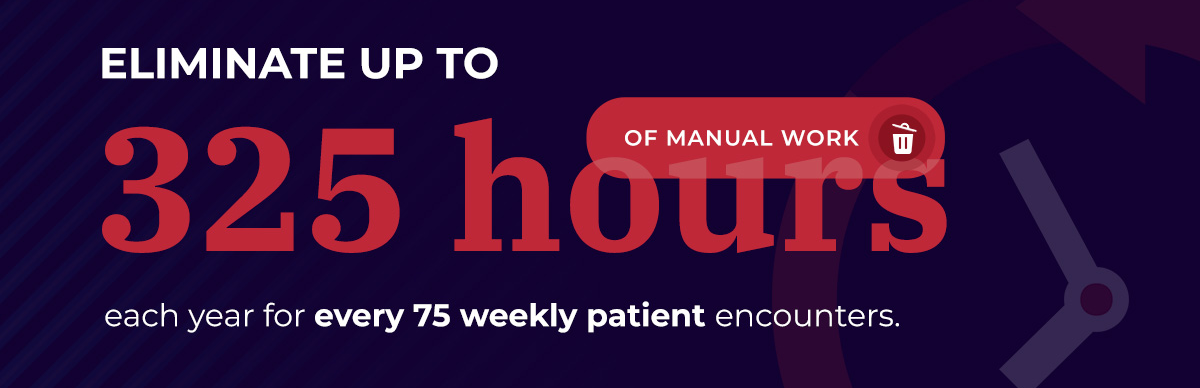
- Less manual work: Eliminate up to 325 hours of manual reconciliation each year for every 75 weekly patient encounters.
- More efficient workflows: Teams can focus on resolving exceptions instead of reviewing every record.
- Daily time savings: Providers can save time every day.
Fewer Claim Denials
Documentation gaps can follow claims through the billing process and surface as denials after submission. Automated reconciliation catches these gaps at the source, flagging missing documentation, unsupported charges, and coding discrepancies before they reach the payer. Claims with outstanding documentation can be placed on hold until the record is complete.
Increased Revenue and Faster Collections
Accurate charge note reconciliation helps organization capture more earned revenue and accelerate reimbursement:
- Recover missed revenue: Healthcare organizations can lose a significant portion of collectible revenue to missed or inaccurate charges.
- Improve financial performance: Ingenious Med clients report an average of $30,000 in additional annual net revenue per physician and a 13-15 times ROI.
- Speed up reimbursement: Resolve discrepancies sooner to support faster claim submission.
Enhanced Audit Readiness and Compliance
Automation creates a clear record of every reconciliation activity, making audits easier to manage:
- Manage audit trails: Track every charge, exception, and resolution with time-stamped records.
- Reduce compliance risks: Identify coding and documentation issues before claims are submitted.
- Strengthen reporting: Maintain consistent documentation to support internal reviews and external audits.
Charge Note Reconciliation Software: Evaluation Checklist
The right solution should fit your existing workflows and revenue cycle goals. Use this checklist when comparing solutions:
- Proven ROI with published case studies and client outcomes
- Native EHR integrations – HL7 and FHIR-compatible data feeds
- Real-time reconciliation dashboard with missing charge visibility
- Exception-based workflow routing with automated provider alerts
- Document viewing without additional EHR logins
- HIPAA compliance, role-based access, encrypted data transfer
- Audit trail logging with timestamps for every action
- Scalability across multiple facilities and specialties
- Dedicated implementation and customer success support
Frequently Asked Questions
1. How Difficult Is It to Set up Automated Charge Reconciliation?
Implementation complexity depends on your hospital or organization’s existing systems, integration needs, and the number of departments and facilities involved. Starting with one department can make implementation easier by giving your team time to test the system and adjust workflows before expanding it across the organization.
2. Can Charge Note Reconciliation Software Integrate With Epic and Cerner?
Yes. For example, Ingenious Med supports integrations with Epic, Cerner, athenahealth, PointClickCare, and more than 1,500 other EHR systems.
3. What’s the ROI of Automated Charge Note Reconciliation Software?
The ROI will vary, depending on your organization’s current processes, patient volume, and the number of missed or inaccurate charges. Ingenious Med clients report an average of $30,000 in additional annual net revenue per physician and a 13-15 times ROI.
4. What’s the Difference Between Charge Capture and Charge Note Reconciliation?
Charge capture records the billable services provided during patient care. Charge note reconciliation checks that those documented services have accurate, corresponding charges.
5. What Is the TRIO Bundle From Ingenious Med?
Ingenious Med’s TRIO bundle brings together Automated Charge Capture, Charge Note Reconciliation, and Document Viewing in one solution. It helps healthcare organizations capture charges, identify discrepancies, and review supporting documentation without relying on separate tools for each part of the process.
Ready to Eliminate Missed Charges?
Automated charge notes reconciliation helps healthcare organizations reduce missed charges, improve revenue integrity, and streamline revenue cycle workflows.
Request a demo to see how Ingenious Med’s charge capture solution can help your organization automate charge note reconciliation and support more accurate reimbursement.
You can also learn more about Automated Charge Capture and Mobile Charge Capture to explore related solutions.
Linked Sources:
- https://ambci.org/medical-billing-and-coding-certification-blog/revenue-leakage-in-medical-billing-original-industry-data-amp-insights
- https://www.gao.gov/products/gao-24-107487
- https://ingeniousmed.com/automated-charge-capture/
- https://ingeniousmed.com/automated-charge-capture/
- https://ingeniousmed.com/optimizing-revenue-with-charge-note-reconciliation-and-document-viewing/
- https://ingeniousmed.com/ingenious-med-introduces-trio-an-ai-bundle/
- https://ingeniousmed.com/demo/
- https://ingeniousmed.com/beyond-the-tech-meet-the-ingenious-med-experts-empowering-your-sucess/
- https://ingeniousmed.com/market-report-2026-ai-in-revenue-cycle-management/
- https://ingeniousmed.com/the-rcm-scorecard-how-well-is-your-healthcare-organization-performing/
- https://calculator.ingeniousmed.com/
- https://ingeniousmed.com/the-rcm-scorecard-how-well-is-your-healthcare-organization-performing/
- https://ingeniousmed.com/ingenious-med-introduces-trio-an-ai-bundle/
- https://ingeniousmed.com/demo/
- https://ingeniousmed.com/automated-charge-capture/
- https://ingeniousmed.com/mobile-charge-capture-key-to-revenue-optimization/